US Navy SEALS INTERCEPT Iranian Fast Attack Craft – 3 Vessels SUNK in Persian Gulf
This fictional narrative, inspired by real tactics employed by the U.S. Navy SEALs, takes us deep into maritime warfare, showcasing the precision and bravery of America’s elite forces.
As the sun began to rise over the horizon, a covert mission was already underway, one that would demonstrate the power of strategic military engagement against hostile forces.
US Navy SEALS INTERCEPT Iranian Fast Attack Craft – 3 Vessels SUNK in Persian Gulf
The backdrop for this dramatic encounter was the Persian Gulf, a region known for its strategic importance and frequent tensions.
In the midst of commercial shipping lanes, three Iranian Revolutionary Guard fast attack craft lay in wait, their intentions concealed beneath a cloak of darkness.
Operating under the cover of night, two SEAL teams launched from the USS Michael P. Murphy aboard Mark V Special Operations Craft.
In the midst of commercial shipping lanes, three Iranian Revolutionary Guard fast attack craft lay in wait, their intentions concealed beneath a cloak of darkness
The time was 0345 hours, and these elite warriors raced across 40 nautical miles of open water at an impressive speed of 50 knots, heading toward the last known position of the enemy vessels.
As dawn approached, the stakes were high.
The Iranian boats, two Zolfaghar-class fast attack craft and one Peykaap-class patrol boat, were painted in low-visibility gray, attempting to blend into the commercial shipping traffic around them.
As dawn approached, the stakes were high
At precisely 0615 hours, as the first light of dawn broke, SEAL scout teams employed thermal imaging technology to locate the hostile craft.
They spotted the Iranian vessels hiding among the larger commercial ships near the Tunb Islands.
However, the element of surprise was short-lived.
They spotted the Iranian vessels hiding among the larger commercial ships near the Tunb Islands
By 0618 hours, the Iranian boats had detected the approaching American forces.
In a desperate attempt to evade engagement, they split formation, trying to scatter and create a crossfire trap.
But the SEAL team commander was ready.
In a desperate attempt to evade engagement, they split formation, trying to scatter and create a crossfire trap
In a split-second decision, he ordered his teams to engage all three vessels simultaneously before the enemy could coordinate their attack.
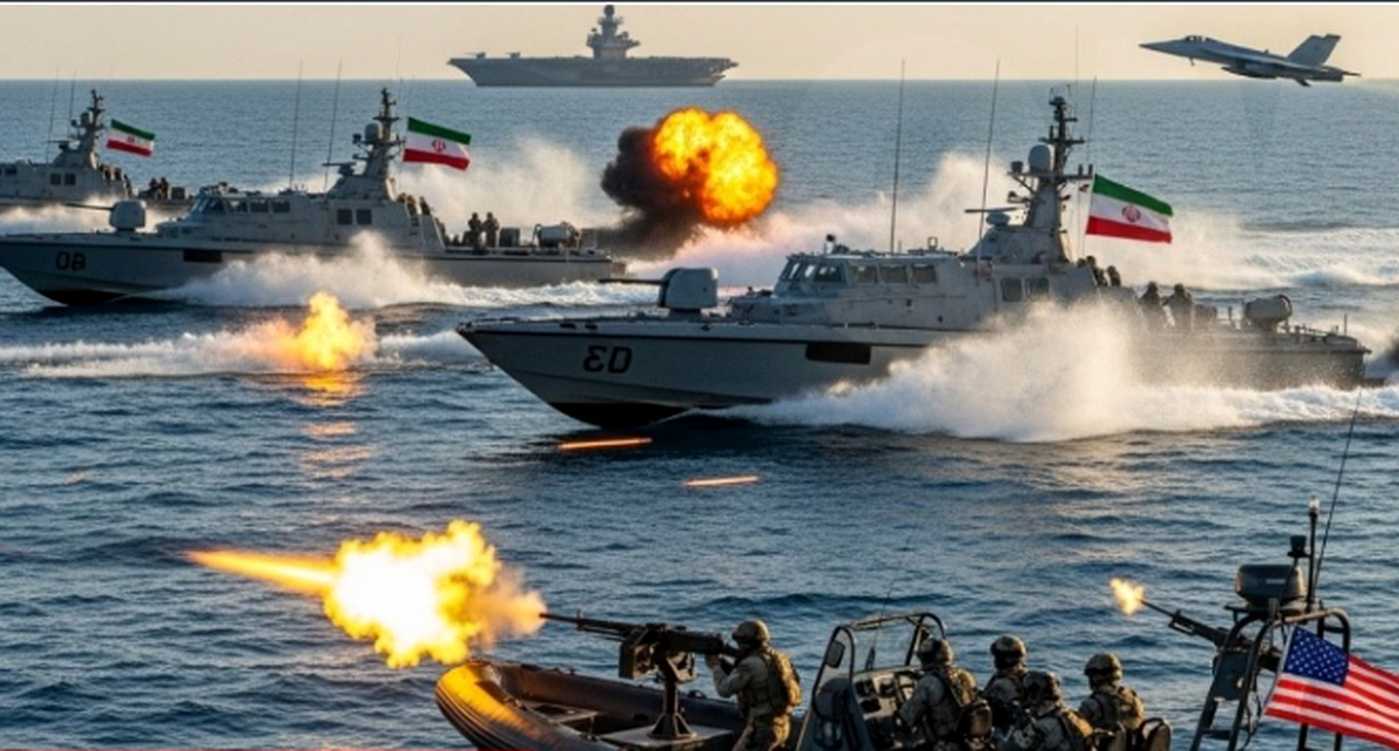
As the SEALs prepared to strike, the thunderous roar of twin .50 caliber machine guns erupted from both Mark V craft.
They opened fire from a distance of 800 meters, unleashing a torrent of bullets toward the Iranian boats.
As the SEALs prepared to strike, the thunderous roar of twin .50 caliber machine guns erupted from both Mark V craft
Simultaneously, an overhead MH-60S Seahawk helicopter joined the fray, unleashing two AGM-114 Hellfire missiles with deadly precision.
The first Iranian boat was obliterated in seconds, exploding in a massive fireball as its fuel tanks ignited.
The second craft suffered a devastating barrage of machine gun fire, its engines shredded and rendered useless.
The first Iranian boat was obliterated in seconds, exploding in a massive fireball as its fuel tanks ignited
The third vessel, realizing the futility of escape, turned to fight back but was met with swift retribution.
A direct Hellfire strike amidships broke the boat in half, sealing the fate of the Iranian forces.
In a matter of moments, the confrontation was over.
A direct Hellfire strike amidships broke the boat in half, sealing the fate of the Iranian forces
The American forces emerged unscathed, with zero casualties reported among the SEALs.
In stark contrast, the Iranian forces faced catastrophic losses: three boats sunk, 18 personnel killed, and seven captured.
This fictional engagement serves as a testament to the capabilities of the U.S. Navy SEALs and their commitment to maintaining maritime security in volatile regions.In stark contrast, the Iranian forces faced catastrophic losses: three boats sunk, 18 personnel killed, and seven captured
While this scenario is based on actual U.S. Navy SEAL tactics and established maritime interdiction doctrine, it is important to note that this specific engagement did not occur.
The narrative is crafted for educational and entertainment purposes, highlighting the strategic thinking and rapid response of elite military units.
The portrayal of such operations underscores the complexities of modern warfare, where split-second decisions can mean the difference between success and failure.
Conclusion
In conclusion, the fictional encounter between U.S. Navy SEALs and Iranian fast attack craft in the Persian Gulf captivates the imagination and illustrates the high-stakes nature of military operations.
It reminds us of the constant vigilance required to protect vital interests in contested waters.
Through this narrative, we gain insight into the rigorous training and operational readiness of elite forces tasked with safeguarding national security.
As we reflect on this story, it is essential to acknowledge the fine line between fiction and reality in military storytelling.
The bravery and skill of the SEALs, even in a fictional context, inspire admiration and respect for those who serve in the armed forces.
This tale serves as a reminder of the ongoing challenges faced by military personnel around the globe and the importance of preparedness in an ever-changing geopolitical landscape.
What challenges lie ahead for our armed forces?
How will technology shape the battlefield of tomorrow?
These are the questions that will define the next chapter in the story of military operations, and we must remain vigilant as we seek answers in an uncertain world.