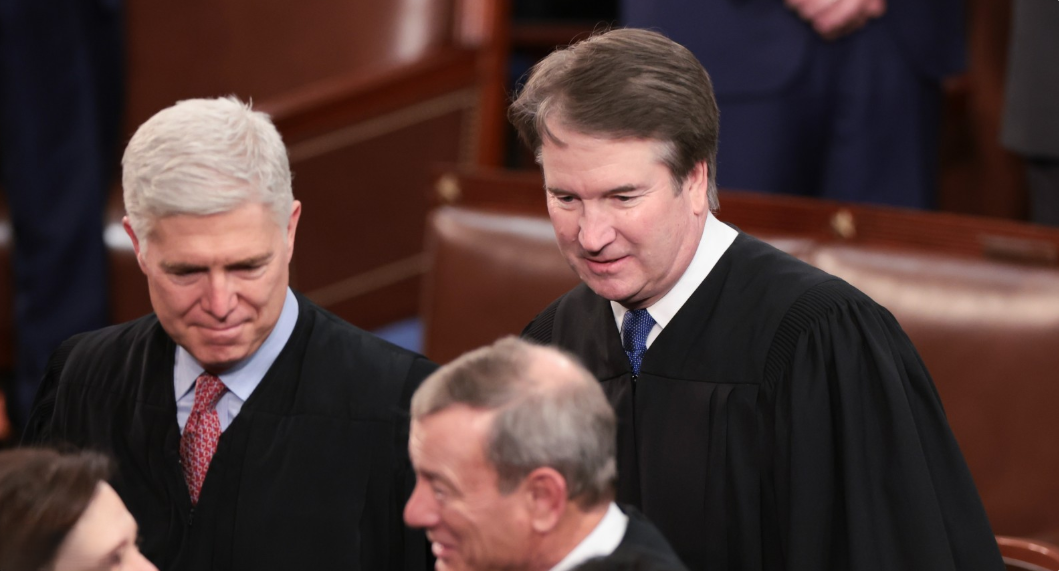
Supreme Court Justices Neil Gorsuch and Brett Kavanaugh issued warnings this summer to lower court judges, cautioning them against defying precedents set by the high court in a series of cases involving President Donald Trump’s administration.
“Lower court judges may sometimes disagree with this court’s decisions, but they are never free to defy them,” Gorsuch wrote.
The decision was related to Trump’s cancellation of nearly $800 million in federal research grants. Kavanaugh joined the opinion, which criticized a district court for disregarding an earlier Supreme Court order.
Gorsuch noted that it was “the third time in a matter of weeks this court has had to intercede in a case ‘squarely controlled’ by one of its precedents.” He added, “When this court issues a decision, it constitutes a precedent that commands respect in lower courts.”
The decision allowed the administration to keep the grants frozen, overturning a ruling from U.S. District Judge William Young, who made the baseless claim he had “never seen government racial discrimination like this.”
Other justices have also criticized lower courts.
Justice Ketanji Brown Jackson and Justice Brett Kavanaugh appeared together at an event for lawyers and judges held at the federal courthouse, with Senior U.S. District Judge Paul Friedman moderating the discussion.
The hour-long session quickly turned into something more revealing than the typical collegial exchange the Supreme Court often projects in public appearances.
Jackson sharply criticized the court’s growing reliance on emergency rulings known as the “shadow docket,” which allows the justices to act without full briefing, oral argument, or detailed written opinions.
While full litigation continues in the lower courts, the court increasingly uses the emergency process to resolve high-stakes disputes involving major national policies.
Jackson expressed her unwavering criticism of the court’s tendency to intervene at the emergency stage in politically sensitive cases.
“I just feel like this uptick in the court’s willingness to get involved … is a real unfortunate problem.”
She described the emergency process as “a warped kind of proceeding” and said it is “not serving the court or this country well.”
Jackson argued that the number of emergency applications reaching the justices could decline if the court were more reluctant to grant them.
She also suggested that frequent Supreme Court intervention may influence how lower court judges approach politically charged disputes, potentially leading them to issue broader rulings in anticipation of Supreme Court review.
Jackson indicated that lower courts may feel pressure to issue sweeping nationwide injunctions if they believe the Supreme Court is likely to step in.
Kavanaugh rejected the criticism and defended the court’s responsibility to act when emergency applications arrive, declaring, “None of us enjoy this.”
Kavanaugh said the court cannot simply ignore emergency requests once they reach the justices. He argued that declining to act would effectively allow a single lower court ruling to dictate national policy.
Emergency rulings from lower courts have increasingly blocked presidential actions nationwide through nationwide injunctions. Kavanaugh said the Supreme Court must respond when those rulings immediately affect federal policy.
He also noted that the surge in emergency litigation is not unique to the Trump administration.
Kavanaugh said the court granted similar requests from the Biden administration, though at a somewhat lower rate.
He argued that the growing number of emergency applications reflects a broader shift in how modern presidents govern.
Presidents from both parties have increasingly relied on executive orders and administrative actions to implement policy.
Kavanaugh said that trend stems in part from Congress struggling to pass legislation in a deeply divided political environment.
When Congress cannot act, he said, presidents often seek to advance policy through executive authority.
Those executive actions frequently face immediate legal challenges in federal court. Kavanaugh said that dynamic has turned the judiciary into a central battleground for political and policy disputes.
He also noted that in some cases, the court has chosen to hear full arguments rather than issue quick emergency rulings. That approach allows the justices to provide longer explanations and more detailed legal reasoning in particularly significant cases.
Kavanaugh praised Chief Justice John Roberts for carefully navigating the court’s tensions. He said Roberts has sought to maintain the court’s institutional credibility amid intense political pressure.
Roberts recently issued a statement rejecting calls from some Trump allies to impeach judges who ruled against the administration. The chief justice said impeachment should not be used as a response to disagreements with judicial decisions.
Jackson acknowledged that the court’s issue is complicated.
“There’s no easy answer, for sure.”
Before that, Justice Samuel Alito said a federal judge had committed an “act of judicial hubris” in a case involving another Trump policy.