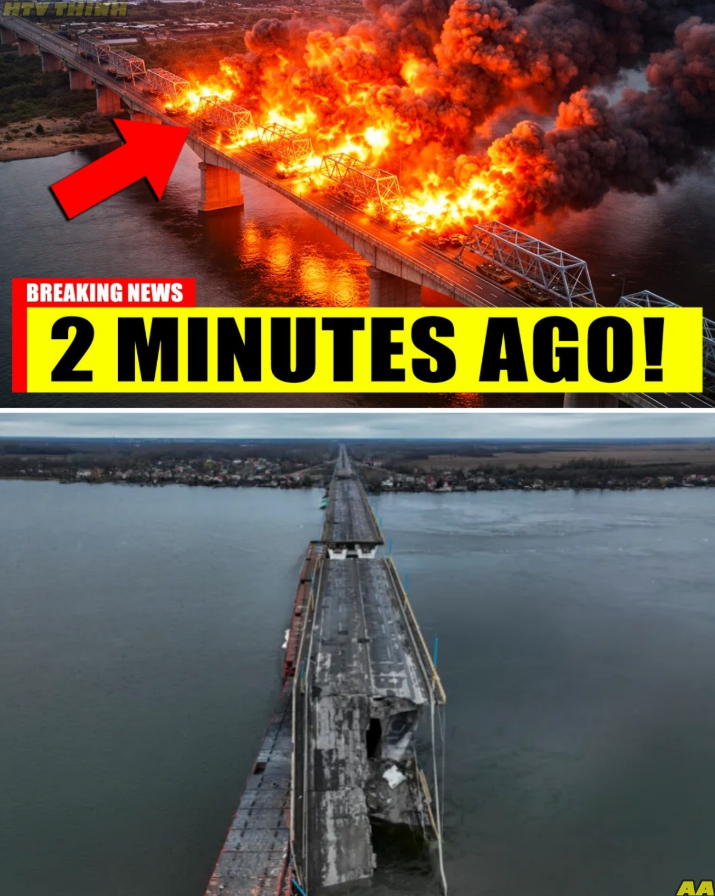
 Russia’s MOST PROTECTED Convoy ENTERS Dnipro Bridge – 60 Seconds Later, GONE
At 0400 local time, a massive Russian logistics convoy approached a crucial bridge spanning the Dnipro River, carrying enough heavy artillery ammunition to sustain 10,000 troops on the southern front for over a month.
The convoy commander, seated in the lead vehicle, was confident in the impenetrable defensive bubble surrounding his trucks.
High above, the airwaves were saturated by the ANEOM radar complex, designed to detect stealth fighters at hundreds of kilometers, while mobile Pancer S1 batteries scanned the immediate airspace for anything larger than a sparrow.
For weeks, Russian forces had prioritized this supply route, fully aware that delivering these munitions would provide immense leverage in any upcoming diplomatic negotiations.
Every sensor, every radar dish, and every pair of binoculars was aimed at the cloudy sky, searching for the high-altitude scream of a cruise missile or the characteristic buzz of a reconnaissance drone.
However, the skies were completely clear, the radar scopes were clean, and the air defense crews believed they were about to execute a flawless escort mission.
Unbeknownst to them, a trap had been set beneath the steel and concrete of the bridge itself, waiting for days.
The Russian forces had no idea they were driving directly into a kill zone, and that was exactly what the Ukrainian planners were counting on.
The Russian defensive strategy relied on the assumption that any threat to a multi-million dollar logistics operation would come from above, falling in the form of guided munitions or loitering drones.
The NABO M radar system, an engineering marvel, combined multiple frequency bands to track aerodynamic and ballistic targets with incredible precision, acting like an omniscient eye in the sky.
To protect this convoy, the Russian military was burning through thousands of liters of diesel fuel and operating equipment worth tens of millions of dollars.
However, this massive technological net had a fatal geometric flaw, one that the Ukrainian Special Operations Command had identified months earlier.
Radar beams cannot penetrate thick reinforced concrete, nor can they scan the surface of a river flowing 50 meters below the bridge deck.
Relying on the Nebo M to protect the underside of the bridge was like installing a bank vault door on a cardboard box; the lock was unbreakable, but the structure around it was completely exposed.

Taking advantage of this blind spot, Ukrainian operatives infiltrated the riverbanks days prior, using the cover of darkness and severe weather to attach a swarm of twelve autonomous first-person view drones directly to the bridge supports.
Disguised as mundane electrical junction boxes and structural maintenance equipment, these devices sat entirely dormant, emitting zero electronic signals while the Russian convoy rolled closer.
These were not standard off-the-shelf consumer drones controlled by an operator with a joystick and a video feed, as transmitting a continuous video signal would instantly alert the Russian electronic warfare units patrolling the corridor.
Instead, these drones were heavily modified with autonomous artificial intelligence and advanced LAR sensors, transforming a piece of hardware that cost less than $3,000 into a self-guiding hunter-killer.
Lidar technology allowed the drones to build a highly detailed three-dimensional map of their environment by bouncing rapidly pulsing laser light off surrounding objects, navigating through the dark steel girders like bats in a pitch-black cave, relying entirely on their own localized perception rather than vulnerable satellite uplinks.
By cutting the cord to the global positioning system, the Ukrainian engineers rendered the entire Russian electronic jamming apparatus completely useless.
The Russian jammers were screaming across every frequency, broadcasting walls of static designed to blind any incoming drone, but the drones under the bridge were not listening.
They were waiting in total electronic silence, suspended by electromagnetic clamps, preserving their battery life for a flight that would last less than sixty seconds but would permanently alter the strategic balance of the southern campaign.
Placing the drones was only the first half of the tactical equation.
The second half required the Russian convoy to stop exactly in the middle of the bridge, a mathematical challenge that Ukrainian intelligence solved by analyzing the enemy’s logistics chain.
For months, analysts had studied satellite imagery of Russian supply trucks, noting a consistent pattern of severe mechanical degradation, specifically the use of cheap, poorly manufactured tires that frequently blew out under heavy loads.
A fully loaded ammunition truck carries tons of explosive cargo, putting immense pressure on its axles.
When one of those substandard tires inevitably failed, the entire vehicle would violently lurch to a halt.
As the convoy commander pushed his column onto the bridge at 40 km/h, the rear axle of the seventh truck in the line finally gave way, shredding its dual tires and locking the brakes.
The driver fought the steering wheel, but the heavy truck skidded sideways, blocking both lanes of the narrow concrete span and forcing the twenty trucks behind it to slam on their brakes, trapping the convoy exactly where Ukraine wanted it.
The moment the convoy bottlenecked, a Ukrainian operator hiding several kilometers down the riverbank observed the traffic jam through a high-powered spotting scope and pressed a single button on a modified transmitter.
A microsecond burst of encrypted data cut through the ambient electronic noise, a signal so brief and heavily compressed that the Russian electronic warfare receivers dismissed it as random atmospheric static.
Beneath the bridge deck, the electromagnetic clamps holding the twelve drones instantly deactivated, dropping the lethal payloads into the dark, freezing air just meters above the rushing water of the Dnipro River.
The drones caught themselves in midair, their rotors spinning up to a high-pitched whine that was completely masked by the chaotic sounds of grinding gears and shouting soldiers up on the bridge.
Skimming just centimeters above the river surface, the swarm immediately organized itself into pre-programmed attack groups, communicating with each other through localized infrared flashes that no radar could ever detect.

Four drones banked sharply to target the fuel tankers at the rear, four accelerated toward the command vehicles at the front, and the remaining four locked their LAR sensors onto the massive structural support columns directly beneath the stalled ammunition trucks.
Up above, the Pancer radar screens remained an absolute perfect green sweep, showing zero threats, while the swarm of flying explosives accelerated to 120 km/h directly beneath their boots.
The illusion of perfect security shattered when a young lieutenant inside a Pancer command vehicle caught a momentary flicker of anomalous electronic noise dancing across his secondary passive sensor screen.
It was not a radar return, but a microscopic spike in local electromagnetic interference reflecting off the steel girders beneath his armored boots.
The Russian doctrine drills operators to trust their instruments over their instincts, but the lieutenant had survived six months on the southern front by doing the exact opposite.
Without waiting for target verification or authorization from the convoy commander, he slammed his hand down on the engagement override and launched a single 57 mm command-guided missile directly toward the source of the anomaly.
The missile ripped off the launch rail, illuminating the misty riverbanks before diving over the edge of the bridge and detonating just meters above the water.
However, the lieutenant had not hit the swarm; he had hit a cheap floating acoustic decoy that Ukrainian operatives had anchored in the river current specifically to mimic the frequency of a drone motor.
The explosion was technically a perfect intercept, but tactically it was a catastrophic error that instantly alerted every Russian soldier on the span.
The shockwave from the interceptor missile slammed into the side of the bridge, turning a manageable mechanical breakdown into absolute uncontrollable panic.
Drivers who were previously trying to carefully navigate around the blown tires of the seventh truck now slammed their accelerators, attempting to force their heavy vehicles past the wreckage.
The narrow lanes of the concrete structure became a tangled mess of grinding metal and locked bumpers, effectively welding the multi-million dollar logistics column into a single immovable target right in the center of the kill zone.
The element of surprise was completely gone, but the Ukrainian planners had anticipated this exact human reaction and programmed the drone swarm to exploit the ensuing chaos.
As the Russian soldiers abandoned their cabs and scrambled for cover behind their armored wheels, the twelve autonomous drones initiated their secondary attack sequence.
The drones’ artificial intelligence instantly registered the frantic radio chatter and the heat blooms of revving engines above them, confirming that the convoy was trapped and perfectly aligned.
The bottleneck that was supposed to protect the Russian forces from an aerial assault had transformed the bridge into a steel cage, trapping thousands of tons of volatile artillery shells in a space no larger than a city block.
Realizing they were under attack from below, the Pancer crews frantically depressed their radar arrays, desperately trying to lock onto the small targets skimming the surface of the Dnipro River.

But engaging a fiberglass drone flying at wavetop height through a forest of concrete bridge pillars is an impossible geometry problem for a system designed to shoot down fighter jets.
The moment the Russian fire control radar swept downward, the Ukrainian drone swarm executed a series of violent radar-evading maneuvers, weaving through the structural supports at over 100 km/h.
Simultaneously, two of the drones acting as electronic warfare nodes activated miniaturized broadband noise emitters, flooding the local X-band frequencies with garbage telemetry.
They were not trying to permanently disable the Pancer system, but merely attempting to blind its tracking algorithms for the ten seconds needed to cross the final distance to the target.
The Russian radar scopes filled with dozens of phantom contacts, jumping wildly from one side of the river to the other, forcing the automated fire control computers to constantly drop and reacquire their locks.
The expensive air defense bubble had been completely inverted, rendered useless by a pair of customized transmitters that cost less than the price of a standard laptop computer.
The situation escalated drastically when an A50 airborne early warning aircraft loitering 30,000 feet above the cloud deck detected the chaotic electronic warfare emissions radiating from beneath the bridge.
The massive flying radar station possesses a sophisticated look-down shoot-down capability, allowing its operators to filter out the ground clutter and isolate the thermal signatures of the drone motors against the cold water of the river.
Instantly realizing the Pancer batteries were compromised, the A50 crew bypassed the local command network and data-linked the precise coordinates directly to an S400 missile battery positioned 40 km away.
Within seconds, the long-range strategic air defense system launched a hypersonic interceptor, a weapon typically reserved for intercepting ballistic missiles or heavily armored bombers toward the river valley.
The missile accelerated to Mach 5, tearing through the atmosphere with kinetic energy so immense that its friction visibly glowed, creating a fiery streak across the dawn sky.
The Russian commanders believed they had finally neutralized the threat, utilizing their most advanced and expensive strategic asset to swat down the incoming swarm before it could reach the critical support columns holding up the bridge.
As the hypersonic missile screamed downward, the Ukrainian drone swarm’s artificial intelligence recognized the incoming threat through its passive threat warning receivers and executed its final, most brilliant defensive countermeasure.
One of the lead drones released a small aerodynamic pod attached to a 50-meter tether, which unspooled rapidly behind it as it flew.
This tow decoy contained a highly calibrated radar reflector and a thermal amplifier specifically designed to project an electronic signature massive enough to mimic a heavily armed attack helicopter.
The S400 interceptor traveling at five times the speed of sound had less than a fraction of a second to make its final terminal guidance decisions, and its seeker head naturally gravitated toward the largest, brightest target in its field of view.
The massive Russian missile bypassed the small fiberglass drones hugging the water and slammed directly into the tow decoy, detonating its heavy fragmentation warhead in a blinding flash that rattled the windows of every vehicle on the bridge.
The spectacular explosion accomplished exactly what the Ukrainian planners had hoped, instantly drawing the eyes and sensors of every Russian defender instinctively skyward to watch the fireball, leaving the dark space beneath their feet completely unmonitored for the critical final seconds of the operation.
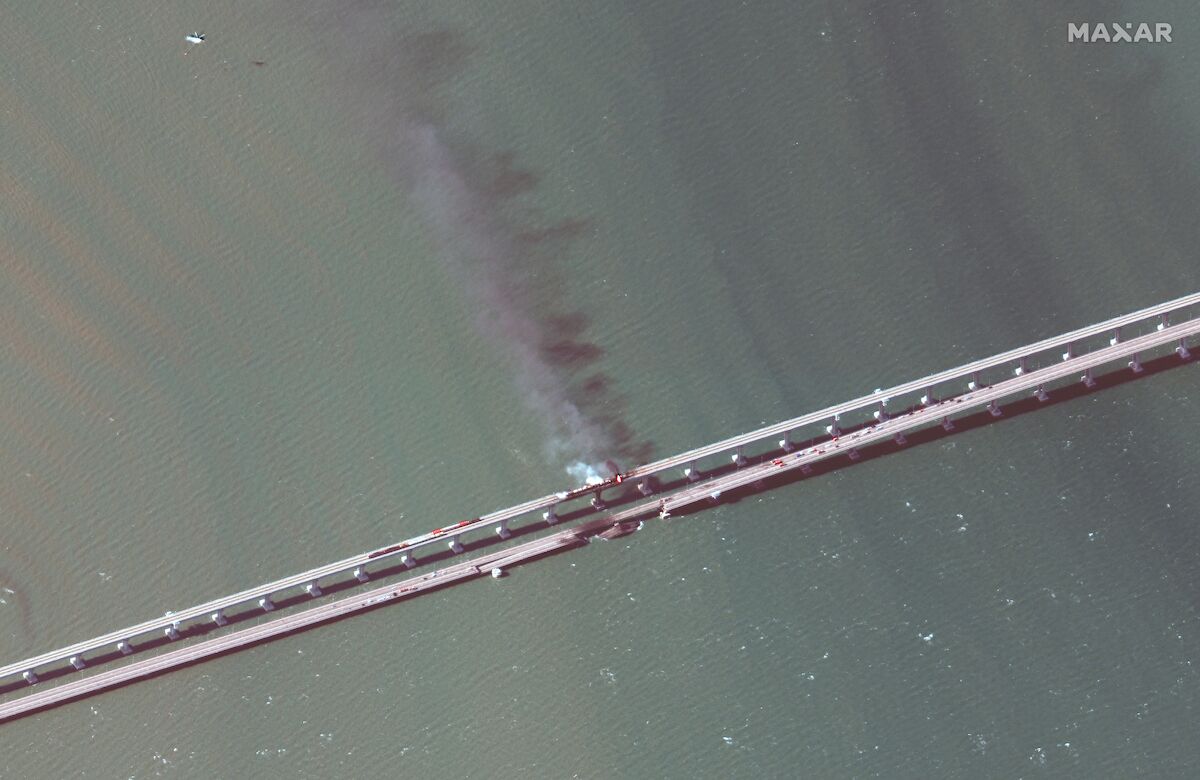
With the entire Russian defensive network staring upward at the dissipating fireball of their own S400 interceptor, the remaining Ukrainian drones entered the final lethal phase of their autonomous flight path.
They did not ascend to attack the heavily armored ammunition trucks directly, as Russian doctrine would have predicted, because a fiberglass drone carrying a 20 kg payload would barely dent the hardened steel plates of a modern military logistics vehicle.
Instead, the artificial intelligence guiding the swarm calculated the exact structural load of the bridge span above them, identifying the critical concrete support columns holding the weight of the massive, completely stalled convoy.
Traveling at maximum velocity, the four primary strike drones banked sharply and slammed directly into the base of the central pillars, perfectly synchronizing their impacts to occur within mere milliseconds of one another.
The drones were equipped with specialized shaped charges designed to penetrate reinforced concrete.
By detonating inside the narrow confined space between the river surface and the underside of the bridge deck, they effectively amplified their explosive yield.
The resulting blast did not dissipate into the open air; instead, the shockwave was forced entirely upward into the structural foundation of the bridge, severing the thick steel rebar and shattering the concrete pillars holding thousands of tons of heavy artillery shells.
The immediate loss of structural integrity caused the center span of the bridge to instantly buckle under the immense concentrated weight of the bottlenecked Russian supply convoy.
As the concrete cracked and gave way, the trapped ammunition trucks began to slide backward, tearing through the guardrails and plummeting 50 meters down into the expanding fireball of the initial-shaped charges.
When the first fully loaded truck struck the ruined pillars below, the impact triggered a catastrophic secondary explosion, igniting hundreds of high-explosive artillery rounds in a chain reaction that completely erased the middle section of the crossing.
The blast wave surged outward with devastating force, sweeping the remaining vehicles off the crumbling deck and turning the expensive Nebo M radar systems and Pancer command vehicles into twisted, unrecognizable scrap metal.
In less than sixty seconds, an operation that relied on multi-million dollar air defense bubbles and hypersonic missiles had been entirely dismantled by a handful of cheap autonomous fiberglass airframes that exploited a single overlooked blind spot.
The smoke rising from the Dnipro River marked not just the destruction of a bridge but the complete annihilation of the logistical lifeline that 10,000 Russian soldiers on the southern front desperately needed to survive the coming winter.
The strategic aftermath of the operation proved entirely catastrophic for the Russian military command, stripping them of the vital leverage they had spent months trying to build for upcoming diplomatic negotiations.
Without that massive shipment of heavy artillery shells and vehicle fuel, the entire southern front was effectively paralyzed, leaving thousands of frontline troops with strictly rationed ammunition and zero offensive capabilities.
The destruction of the convoy forced Russian generals to completely rewrite their operational strategy, proving that accumulating massive amounts of conventional military hardware is useless if the logistics network feeding it can be severed by a $3,000 drone.
This brilliantly executed ambush perfectly illustrates the fundamental transformation of modern warfare, where highly adaptable artificial intelligence and asymmetric technological strategies consistently outmaneuver rigid traditional military doctrines.