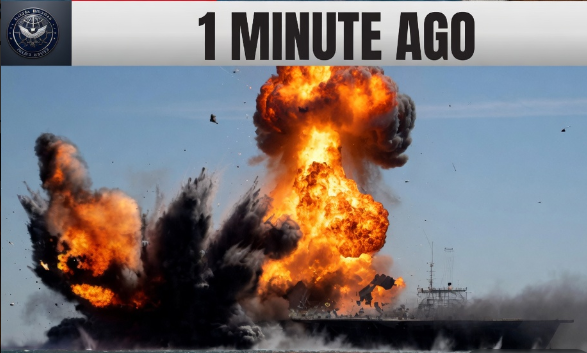
The long-standing, tense status quo in the Strait of Hormuz was violently dismantled when a routine naval transit transformed into a full-scale military confrontation. For years, the waterway had been governed by a “choreography of deterrence,” characterized by surveillance and radio warnings. However, Iran broke this script by launching a multi-missile barrage from concealed coastal positions, targeting a United States Navy carrier strike group. This sudden escalation tested the limits of regional stability and the defensive capabilities of modern naval technology, representing a profound misjudgment by Tehran regarding the speed and integration of American responses.
The focal point of the assault was the USS Theodore Roosevelt, which suddenly found itself the target of multiple anti-ship missiles. At 2:31 PM, the threat matrix populated with trajectory lines and velocity estimates indicating a high-volume, supersonic assault. Under the steady command of Captain Chen, the crew moved with mechanical precision, replacing the initial shock of the attack with the drilled reflexes of combat doctrine. The atmosphere on the bridge remained one of disciplined calm, even as the sky above the Strait became a chaotic lattice of smoke trails and intercept arcs.
The defense of the Roosevelt was a masterclass in multi-layered naval warfare. Aegis-equipped destroyers served as the fleet’s primary shield, launching SM-2 interceptors that climbed into the sky to meet the incoming threats. Simultaneously, electronic warfare teams worked to saturate the spectrum with jamming signals. These countermeasures were designed to “seduce” the missile guidance systems away from the steel hulls of the strike group and into the empty sea. Automated close-in weapons systems provided the final layer of protection, building a literal wall of metal against any projectiles that managed to penetrate the outer intercept arcs.
The results of the defensive phase were absolute: by the twelfth minute of the engagement, more than half of the Iranian missiles had been torn apart in mid-flight, their debris raining harmlessly into the Persian Gulf. Not a single hostile weapon reached the Roosevelt. The failure of the Iranian barrage immediately shifted the tactical calculus from defense to retaliation. The United States response was swift and overwhelming, utilizing a combination of standoff weapons and carrier-based air power to neutralize the source of the aggression.
Tomahawk cruise missiles, launched from positions safely outside the range of retaliation, hugged the terrain as they sped toward the coastal batteries
Tomahawk cruise missiles, launched from positions safely outside the range of retaliation, hugged the terrain as they sped toward the coastal batteries. Simultaneously, strike fighters launched from the Roosevelt, carrying precision-guided munitions toward identified command nodes and radar installations. The counter-strike was surgical; within thirty minutes of the initial Iranian launch, the very batteries that had attempted to challenge the carrier were reduced to smoking wreckage, leaving Iran’s coastal confidence fractured.
This confrontation serves as a critical case study in modern naval engagement. It demonstrates that the effectiveness of a carrier strike group is not merely a matter of superior hardware, but of the integration of data and the discipline of the crew. For the United States, the incident reaffirmed the lethality of its integrated defenses. For Iran, the attempt to calibrate escalation ended in a total loss of infrastructure, proving that the illusion of parity in the Strait of Hormuz is no substitute for the overwhelming reality of maritime power.