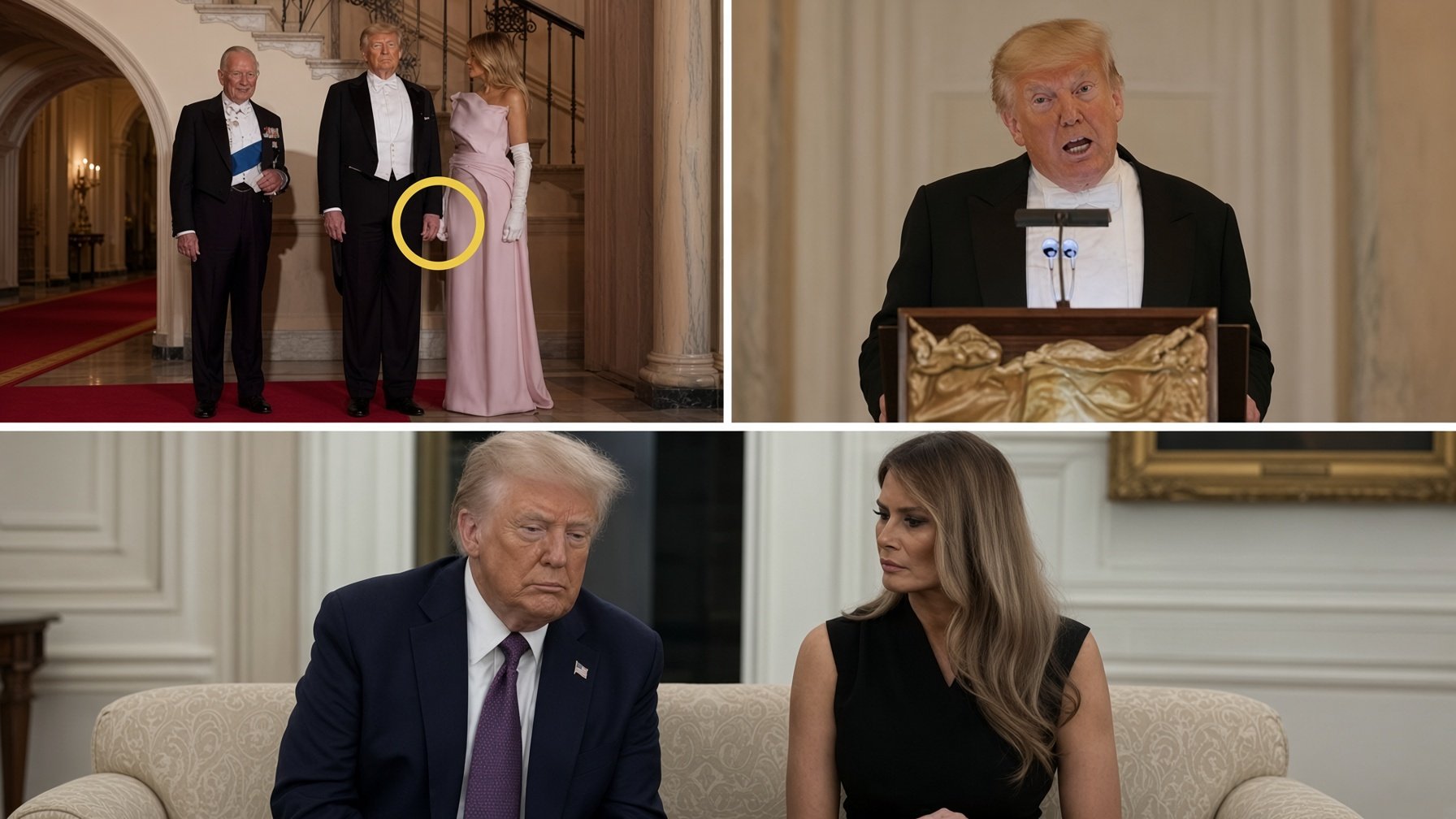
Article description: A dramatic social media headline claims Melania Trump “smacked” Donald Trump’s hand. But what does the wording actually establish, and why should readers look beyond a provocative caption before deciding what happened?
Sapo: A viral headline about Melania and Donald Trump sparks curiosity, but
missing context makes verification essential.
Chapter 1: The Headline That Turns a Brief Gesture Into a Viral Story
A striking headline can transform an ordinary photograph, a brief interaction, or a few seconds of video into a story that attracts thousands of reactions. That is the central issue behind the social media headline claiming that Melania Trump “smacked” Donald Trump’s hand. Presented alongside an emotional opening, a broken-heart symbol, and the familiar phrase “See more,” the headline is designed to make readers curious enough to click before they have learned what actually happened.
The wording is provocative. The expression “smacked” suggests a deliberate and forceful action, while the phrase “disgusted Melania” assigns an emotional state to the person involved. Together, these words encourage readers to interpret a physical gesture as evidence of a personal disagreement. Yet the headline, by itself, does not provide enough information to support that conclusion.
There are several unanswered questions. When did the alleged interaction take place? Where were the two people standing? Was the moment captured in a complete video or only in a photograph? What happened immediately before the gesture, and what happened afterward? Did either person explain the interaction? Most importantly, is there reliable evidence supporting the interpretation presented in the headline?
Without answers to these questions, readers cannot responsibly determine whether the description is accurate.
This distinction matters because a headline is not the same thing as a verified account. A headline is a short piece of writing intended to summarize or promote a story. Sometimes it communicates the essential facts clearly. At other times, especially in highly emotional social media posts, it emphasizes a dramatic interpretation while leaving the underlying evidence unexplained.
The headline in question creates a narrative before presenting the details. Readers are invited to imagine a moment of anger, rejection, or tension between two well-known public figures. That imagined scene can become the dominant impression even when the post has not established the circumstances surrounding the gesture.
A photograph may show two people standing close together. A short video may capture one person moving a hand away from another. Neither image automatically establishes the reason for the movement. The same visible action can have different explanations depending on the setting, the sequence of events, and the intentions of the people involved.
For example, someone might move a hand because of an awkward position, a change in direction, a crowded walkway, a request from an event organizer, or a simple preference about physical contact. Another person might interpret the same movement differently. The image alone cannot necessarily distinguish between these possibilities.
This does not mean that every dramatic headline is false. It means that the strength of a claim should match the strength of the evidence supporting it. If a post offers only a short phrase and a few photographs, readers should be cautious about accepting a detailed explanation of someone’s emotions or private relationship.
The word “fact check” also deserves careful attention. A genuine fact-checking process does not simply replace one dramatic conclusion with another. It examines the original claim, identifies the evidence required to assess it, checks the relevant records, and explains what can and cannot be established.
In this case, the headline and accompanying material shown in the screenshot do not provide enough evidence to confirm the emotional interpretation. The appropriate conclusion is therefore limited: the claim is presented in a sensational way, but the headline alone does not prove what happened or why.
That conclusion may seem less exciting than the original wording. However, responsible reporting is not measured by how dramatic a conclusion sounds. It is measured by whether the conclusion is supported by reliable evidence.
The first step for any reader is simple: separate the visible event from the interpretation attached to it. What can actually be seen? What is merely being suggested? And what information is still missing?
Those questions turn a potentially misleading headline into an opportunity to practice careful media consumption.
Chapter 2: Why Sensational Headlines Spread So Quickly
Sensational headlines have a significant advantage in a crowded digital environment: they compete for attention by promising an emotional payoff. People encounter a continuous stream of photographs, videos, news updates, advertisements, and personal posts. They rarely have time to examine every item in detail. A headline that creates surprise, outrage, or curiosity can therefore stand out from dozens of ordinary updates.
The wording used in the Melania and Donald Trump headline follows a familiar pattern. It begins with an emotionally charged label, introduces a claim involving two recognizable public figures, and then withholds the rest of the story behind “See more.” This structure gives readers a reason to open the post because the most important information appears to be just beyond the visible text.
Curiosity is a powerful motivator. When a headline presents an incomplete story, people naturally want to fill in the gaps. They may click to discover what supposedly happened, whether the claim is true, or how the people involved reacted. The less information the headline provides, the more room readers have to imagine possible explanations.
Emotion adds another layer. A claim about a disagreement between prominent figures can appeal to people who already have strong opinions about them. Some readers may expect the story to confirm their existing views. Others may be interested in celebrity relationships, public appearances, or unusual moments captured on camera. Still others may simply want to see what everyone is discussing.
These different motivations can bring attention to the same post, even when readers do not agree about its meaning.
Social media also makes sharing remarkably easy. A user can forward a headline, repost a photograph, or add a comment without reading the complete article. Once a claim begins circulating, later viewers may encounter it through several different accounts. Repetition can make the story seem familiar, and familiarity can sometimes be mistaken for credibility.
However, seeing the same claim multiple times does not necessarily mean that several independent sources have confirmed it. Ten accounts may all be repeating a single original post. If none has checked the underlying evidence, the number of shares tells readers little about the accuracy of the claim.
The design of a post can reinforce this effect. Large lettering, emotional symbols, cropped images, and incomplete sentences can direct attention toward a particular interpretation. A small visual detail may be highlighted while the broader scene remains unseen. The result can be a strong impression that feels convincing before the reader has evaluated the facts.
The phrase “See more” is not inherently misleading. It is a normal feature of social media interfaces. The problem arises when the visible portion of a post makes an emotionally significant claim while withholding the context necessary to understand it. Readers may form an opinion before they reach the additional information, assuming that the rest of the story will simply confirm what the headline implies.
Another important factor is the difference between engagement and accuracy. A post that provokes arguments may receive more comments than a careful explanation. People may share it to express anger, make a joke, defend a public figure, or criticize the headline. These reactions can increase the post’s visibility even when many participants doubt its claims.
High engagement is therefore not a reliable measure of truth. It indicates that a post has attracted attention, not that its content has been independently verified.
There is also a commercial incentive behind some sensational content. Websites and social media pages may benefit when readers click through to view a story, encounter advertisements, or spend additional time on a page. This does not mean that every publisher using an engaging headline is dishonest. It does explain why some headlines emphasize the most dramatic interpretation rather than the most carefully qualified one.
The solution is not to reject every emotionally written story. Human experiences can be genuinely surprising, upsetting, or amusing, and journalism can describe those reactions when they are supported by evidence. The important distinction is between reporting an established event and using emotional language to encourage an interpretation that has not been demonstrated.
When readers encounter a headline such as the one about Melania and Donald Trump, they should pause before reacting. Is the post describing a visible action, or is it claiming to know what someone felt? Does it offer a source? Does it identify when the event occurred? Is the story based on complete footage, a cropped image, or a secondhand description?
The answers help readers decide whether the post deserves further attention.
A sensational headline can be an invitation to investigate, but it should never serve as the final verdict.
Chapter 3: Why Context Matters When Interpreting Photographs and Videos
Images are powerful because they allow people to see a moment for themselves. A photograph can preserve a facial expression, a movement, or an interaction that might otherwise be forgotten. Video can provide even more information by showing how an event unfolds over time. Nevertheless, visual evidence is not automatically self-explanatory.
A camera records what appears within its frame. It does not necessarily capture everything happening outside that frame, and it does not directly reveal the thoughts or intentions of the people being filmed.
Consider a brief hand movement during a public appearance. A still image might capture the instant when one person’s hand moves away from another person’s hand. Depending on the exact frame, the action could appear abrupt, dismissive, playful, or entirely ordinary. A viewer who sees only that image may be unable to tell which interpretation best fits the full interaction.
The problem becomes more complicated when a photograph is cropped. Cropping can be useful for emphasizing a subject, but it can also remove details that would change the viewer’s understanding. A wider image might show that the people were walking through a narrow space, responding to an event official, or adjusting their positions for a photograph. A tight crop might conceal all of that information.
The same principle applies to video. A clip that begins immediately before a gesture and ends immediately afterward may exclude the actions that explain it. A person’s hand might move for a reason that becomes clear only several seconds earlier. Alternatively, a gesture may look more dramatic when it is slowed down, replayed repeatedly, or accompanied by suggestive music and commentary.
None of these techniques automatically makes a video false. Editing is a normal part of producing news reports, documentaries, and entertainment. The concern is whether the editing changes the apparent meaning of the original event or encourages viewers to reach a conclusion that the full footage does not support.
Audio can also influence interpretation. A video with no sound may leave viewers uncertain about what was said. Adding a dramatic voice-over can push them toward a particular explanation, even if the narrator has no direct evidence of the people’s intentions. A caption may then reinforce that interpretation until it feels like an established fact.
There is a further distinction between observation and inference. Observation describes what can be directly seen or heard. Inference is a conclusion drawn from that observation.
For example, a careful description might say that one person moved a hand away during a public appearance. A stronger interpretation might claim that the person was angry. A still more specific claim might assert that the gesture demonstrated disgust toward a partner. Each step introduces information that may not be visible in the original footage.
The more specific the interpretation becomes, the more evidence it requires.
Facial expressions are particularly easy to misread. A serious expression does not necessarily indicate anger. A smile does not always establish happiness. Looking away does not prove that someone is avoiding another person. People may react to bright lights, unfamiliar surroundings, photographers, conversations outside the camera’s view, or the ordinary demands of appearing at a formal event.
Body language can provide useful clues when interpreted cautiously and in context. It is not a dependable shortcut for diagnosing a person’s emotional state or determining the quality of a private relationship from a few seconds of footage.
This is especially important when the people involved are public figures. Their appearances are often recorded from multiple angles, photographed by numerous outlets, and discussed by audiences with sharply different opinions. The same gesture may be described as affectionate by one commentator and hostile by another.
The existence of disagreement does not mean that the truth is impossible to determine. It means that the evidence must be examined carefully rather than replaced with speculation.
A useful verification process begins with the earliest available version of the photograph or video. Readers should look for the original recording, the full event footage, or a complete sequence from a reliable broadcaster or photographer. They should then compare the viral version with the original and note whether any material has been removed, rearranged, slowed down, or presented with misleading narration.
The timing also matters. An old photograph can be recirculated as if it were new. A clip from one event can be placed beside an unrelated headline. An authentic image can be used to support an inaccurate description of what happened. In these cases, the picture itself may be genuine even though the claim attached to it is misleading.
For the Melania and Donald Trump headline, the key question is not simply whether a photograph shows them together. The relevant question is whether the available evidence establishes the particular action and emotional interpretation claimed by the headline.
Based on the screenshot alone, that standard has not been met. Readers need the original context and reliable corroboration before reaching a firm conclusion.
The lesson extends well beyond one couple or one viral post. Whenever
an image appears to reveal a dramatic moment, the viewer should ask what happened before the frame, what happened after it, and whether the accompanying words accurately describe what can be seen.
A photograph can be authentic while the story built around it remains unproven. Recognizing that distinction is essential to responsible digital reading.
Chapter 4: A Practical Guide to Checking Viral Claims Before Sharing Them
Verifying a viral claim does not require specialized equipment or professional training. In many cases, a few deliberate steps can help readers distinguish between a supported report and a provocative post that leaves important questions unanswered.
The first step is to identify the exact claim. This sounds simple, but social media headlines often combine several assertions into one sentence. The headline about Melania and Donald Trump, for example, does more than suggest that a hand movement occurred. It uses an emotionally charged description and implies that the gesture reflected disgust. Those are separate elements that need to be evaluated separately.
A reader should ask: What physical action is being alleged? What emotion is being attributed to the person? What evidence would establish each part? This approach prevents a visible movement from being treated as automatic proof of a private intention.
The second step is to find the original material. If a post includes a photograph, look for the complete image and its earliest available publication. If it includes a video, try to locate the full recording rather than relying on a short excerpt. The original source may provide the date, location, event details, and surrounding actions that a repost has omitted.
The third step is to check the source publishing the claim. Does the page identify its authors? Does it explain where the information came from? Does it distinguish confirmed facts from commentary? Does it correct errors when they are discovered? A professional-looking website or a large social media following is not enough to establish credibility.
Readers should also be alert to vague references such as “people are saying,” “sources claim,” or “the internet is shocked.” Such phrases may describe public reaction, but they do not identify the evidence supporting the underlying allegation. A reliable report should make it possible to understand how its central claims were established.
The fourth step is to look for independent confirmation. Search for coverage from established news organizations that have reported the same event independently. The word “independent” matters. Several websites repeating identical language from one original post do not necessarily constitute several separate confirmations.
When multiple credible outlets report the same basic facts using their own reporting, confidence may increase. However, readers should still check whether the reports are based on original footage, direct statements, or simply on one another’s accounts.
The fifth step is to evaluate the wording. Headlines often use strong verbs because concise language can make a story more engaging. But words such as “smacked,” “humiliated,” “exposed,” or “destroyed” may carry implications beyond what the evidence demonstrates. Readers should compare the headline with the actual description in the article.
If the headline says that someone was furious but the story only shows a serious facial expression, the emotional claim may be overstated. If the headline claims that a person rejected another individual but the footage shows only a brief change in hand position, the conclusion may go beyond the available evidence.
The sixth step is to examine the date and setting. An old clip can return to public attention years after it was recorded. A photograph from a diplomatic visit may be circulated without identifying the event. A new caption can then encourage readers to believe that the image shows a recent development.
Checking the date helps prevent confusion between an old moment and a new event. It also allows readers to locate other photographs, full recordings, and contemporary reporting from the same occasion.
The seventh step is to use fact-checking resources when appropriate. Established fact-checking organizations may investigate whether a photograph has been manipulated, whether a quotation is authentic, or whether a viral interpretation is supported by the original footage. Their reports can be useful, particularly when a claim has spread widely.
However, readers should examine the explanation rather than relying only on a rating or label. A good fact-check identifies the claim, describes the evidence, explains the reasoning, and clarifies any remaining uncertainty. This makes it easier to understand not only the conclusion but also why that conclusion was reached.
The eighth step is to consider what cannot be known. Even authentic footage may not reveal a person’s private thoughts. If there is no direct statement or other reliable evidence explaining a gesture, the honest conclusion may be that the motivation remains uncertain.
Admitting uncertainty is not a failure. It is a necessary part of accurate reporting. A responsible assessment should not pretend to know more than the evidence allows.
Finally, readers should pause before sharing the story. Ask whether the post gives enough information for someone else to understand what happened accurately. If the answer is no, consider sharing a reliable report with context instead, or wait until better evidence becomes available.
A simple checklist can help:
Does the post identify the event, date, and location?
Is the original photograph or full video available?
Does the source explain how it verified the claim?
Do independent, credible outlets support the central facts?
Does the headline describe visible evidence or speculate about emotions?
Is the material current, authentic, and presented in context?
What remains unknown?
Would sharing the post spread an unverified interpretation?
These questions take little time, but they can prevent a misleading impression from spreading further. They also encourage a healthier relationship with online information: curiosity remains welcome, while certainty must be earned through evidence.
Chapter 5: Responsible Sharing, Public Figures, and the Importance of Getting the Story Right
Public figures attract extraordinary attention. Their appearances, comments, clothing, facial expressions, and interactions are often scrutinized by audiences around the world. A brief moment can become a widely discussed story because it involves recognizable people and appears to offer a glimpse into their personalities or relationships.
That attention creates opportunities for legitimate reporting. Public appearances can reveal important information about political events, official duties, public statements, and the way leaders interact with others. Photographs and videos can document moments that deserve careful examination.
At the same time, the attention surrounding prominent people can encourage speculation. A gesture that would pass unnoticed at an ordinary gathering may become the subject of thousands of posts when it involves a famous couple. The resulting discussion may focus less on what is known and more on what viewers believe the moment symbolizes.
The headline about Melania and Donald Trump illustrates the risk. By describing a gesture as a “smack” and assigning an emotional state to Melania, the wording encourages readers to view the interaction through a particular narrative. Yet the screenshot does not establish the full circumstances or provide sufficient evidence to confirm that interpretation.
It is possible to discuss the headline critically without claiming to know what the people involved were thinking. That is the central principle of responsible commentary: evaluate the information that is available, identify unsupported assumptions, and avoid replacing one speculation with another.
The same standard should apply regardless of a reader’s political views. Someone who supports Donald Trump may be inclined to dismiss a negative story immediately. Someone who opposes him may be more likely to believe a dramatic allegation. Both reactions can interfere with careful evaluation if they occur before the evidence is examined.
A useful question is whether the reader would apply the same standard if the people in the photograph were different. Would the claim still seem convincing if it involved a public figure they admired? Would they accept the same evidence if the headline supported an opinion they disliked? Consistent standards help prevent personal preferences from determining what counts as credible information.
Responsible sharing also involves recognizing the difference between criticism and misinformation. Public figures can be questioned, scrutinized, and criticized on the basis of documented conduct. A person does not need to accept every official explanation or avoid discussing uncomfortable events. However, criticism is stronger when it relies on verifiable facts rather than exaggerated descriptions.
When evidence is incomplete, readers can express that uncertainty openly. Instead of repeating a claim as established fact, they might say that a headline is circulating but that the available material does not confirm its interpretation. This wording preserves the opportunity for discussion without turning speculation into an assertion.
Publishers have a similar responsibility. A compelling headline can attract attention, but the article should explain the evidence behind it. If the story concerns a public interaction, readers should be given enough context to understand when and where it happened. If a conclusion is uncertain, the article should make that limitation clear.
The photographs accompanying a report should also be presented honestly. Captions should identify what is known about the image and avoid assigning motives that cannot be established. If a photograph illustrates a general topic rather than the specific event under discussion, that distinction should be clear to the reader.
Corrections are equally important. Sometimes new evidence emerges after a story has been published. A responsible publisher should update the report, explain material changes, and correct mistakes rather than allowing an inaccurate impression to persist. Trust is strengthened when an organization demonstrates that accuracy matters more than defending an earlier headline.
Readers can contribute to this environment by rewarding careful reporting with their attention. Before sharing an emotional post, they can open the complete article, inspect the evidence, and check whether the account is supported elsewhere. They can avoid passing along cropped images with speculative captions. They can also correct misinformation politely when reliable evidence shows that a claim is inaccurate.
These actions may seem small, but information travels through networks of individual decisions. Every repost can extend the reach of a claim, while every careful check creates an opportunity to interrupt an unsupported narrative.
It is also worth remembering that public figures remain people. Their public conduct can be scrutinized, but their private emotions should not be treated as established facts merely because a camera captures an ambiguous expression. Respect for evidence does not require avoiding difficult questions. It requires separating what can be observed from what is being inferred.
In the case of the viral headline, the most defensible conclusion is straightforward: the wording is emotionally charged, and the screenshot does not provide enough context to verify its interpretation. That does not prove that every aspect of the story is false. It means that readers should not accept the headline as confirmation of the alleged motive or meaning of the gesture.
The final lesson is broader than the individuals involved. Online information often arrives packaged as a complete story before the evidence has been fully presented. A dramatic headline may tell readers how to feel before it tells them what happened. The responsible response is to reverse that order: establish the facts first, examine the context, and only then decide what conclusions are justified.
Final Thoughts: Read Beyond the Headline Before Reaching a Conclusion
The viral headline claiming that Melania Trump “smacked” Donald Trump’s hand demonstrates how a few emotionally charged words can shape the interpretation of a public moment. The phrase encourages curiosity, but it does not establish the circumstances of the interaction or prove the emotional explanation attached to it.
A careful reader should look for the original footage, verify the date and setting, compare credible reports, and distinguish visible actions from assumptions about private feelings. If the evidence remains incomplete, uncertainty is the most accurate conclusion.
The internet rewards speed, strong reactions, and dramatic storytelling. Reliable information, however, depends on patience, context, and verification. Before clicking, commenting, or sharing, readers should ask one essential question: Does the evidence actually support the story the headline is telling?
That simple habit can help prevent misleading claims from spreading and make online discussions more informed, fair, and useful.