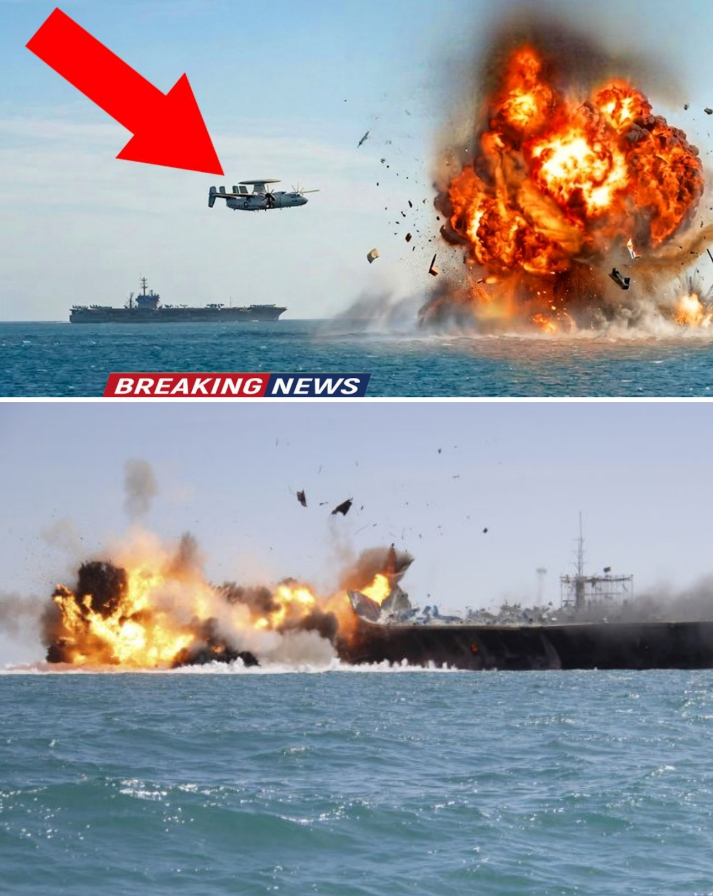
At 2:47 a.m. local time, the atmosphere aboard the USS Gerald R. Ford shifted dramatically.
The bridge, once a control room, transformed into a nerve center overwhelmed by data.
The Persian Gulf sky was no longer a tranquil blue; it morphed into a chaotic red electromagnetic storm filled with incoming threats.
Fifty cruise missile vectors raced through the airspace over the Strait of Hormuz, traveling at Mach 0.9 and closing in at a distance of 30 miles.
In this narrow corridor, the 100,000-ton supercarrier was no longer a warship but a solitary block of steel surrounded by danger.
The pressing question was no longer how to evade the incoming missiles; physics dictated that a supercarrier could not make sharp turns.
Instead, the focus shifted to how to manipulate reality in this perilous situation.
At 2:48 a.m., the towering Zagros cliffs served as more than just geographical features; they acted as amplifiers for Iranian radar systems.
The cliffs weaponized the geology, causing radar pulses from the Ford to scatter rather than reflect linearly.
This created a dense clutter that could confuse even the most advanced detection systems, making it nearly impossible to distinguish between genuine threats and harmless objects.
The Ford’s combat management system, designed to scan 1,000 targets per second, was inundated with thousands of Mylar balloons and cheap aluminum foil decoys scattered across the Strait.
A deadly silence enveloped the AI logic as it grappled with the overwhelming data.
For 45 seconds, the computer was paralyzed, unable to differentiate between a drifting birthday balloon and a supersonic cruise missile.
In that critical moment, five real cruise missiles descended to just 10 feet above the ocean’s surface, effectively hidden beneath a veil of Doppler interference.
At 2:50 a.m., the radar scope erupted with activity.
First, there were 50 contacts, then 100, and soon 200.
To the naked eye, it appeared as though the sky was collapsing under the weight of an overwhelming assault.
However, this was not a fleet of missiles; Iran had successfully saturated the bottleneck with a chaotic mix of Mylar balloons, reflective kites, and lightweight drones designed to induce computational paralysis.
The A/Spy-6V radar, the most advanced active electronically scanned array in existence, was overwhelmed by false positives.
Every piece of foil generated a high-fidelity radar cross-section, triggering the combat management system to enter a mandatory validation loop.
The AI was drowning in ghost targets, struggling to differentiate between a cruise missile flying at 700 feet per second and a drifting balloon.
While the AI choked on this data overload, the real threat—the five sea-skimming supersonic missiles—was closing in, hidden beneath the chaos.
The Ford’s sensors were buried under digital debris, but in the U.S. Navy, the ability to engage threats doesn’t rely solely on local eyes.
Instead, it is part of a larger network known as NFC-CA, the most lethal eyes-on-target network ever built.
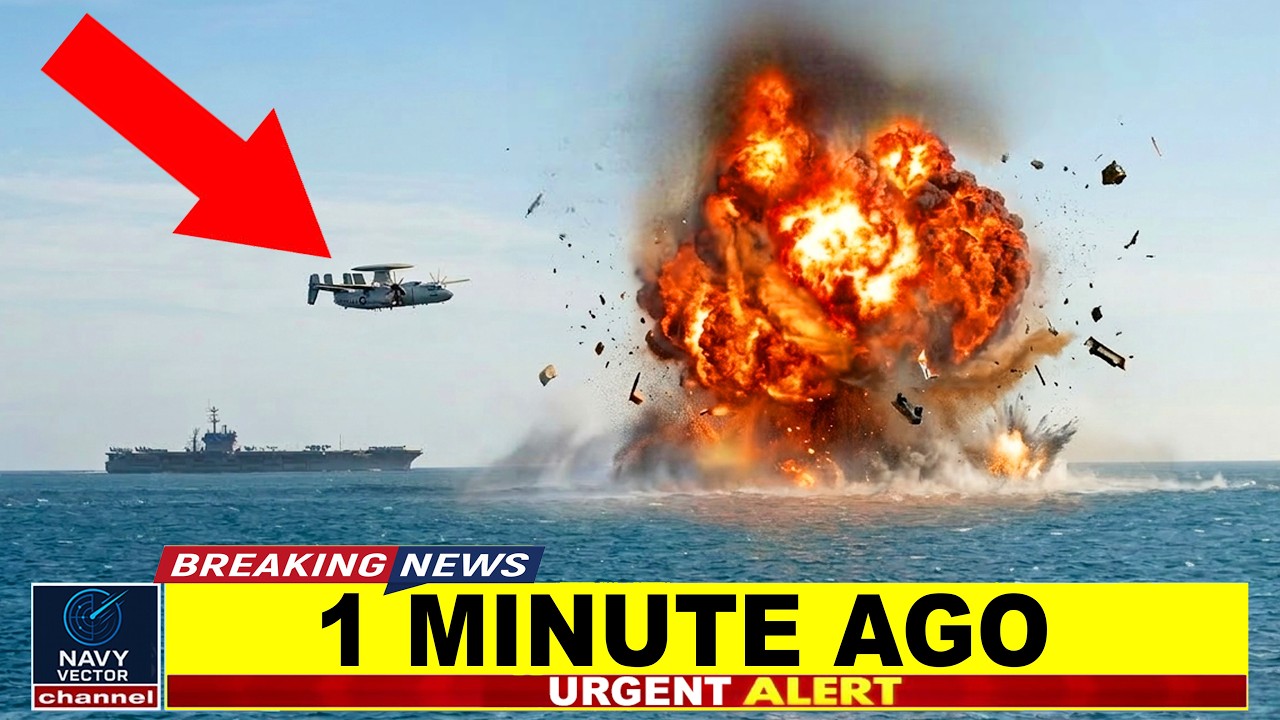
Circling 30,000 feet above the confusion, an E2D Advanced Hawkeye aircraft focused its radar downward through the storm of clutter.
From its vantage point, the Hawkeye was not misled by the thousands of targets; it identified the five missiles skimming the water’s surface with precision.
Although the Ford’s AI struggled, it no longer needed its own eyes.
Through the Link 16 tactical data relay, the Hawkeye transmitted a fire control-quality track directly into the Ford’s combat brain.
Bypassing the clutter, the Ford delegated the firing solution to a USS Burke-class destroyer lurking 10 miles offshore in pristine waters.

The carrier did not even need to see the missiles on her primary scope; she simply triggered the launch command.
The destroyer’s cells opened, and a salvo of SM-6 interceptors screamed into the sky, guided not by the Ford’s confused radar but by the E2D’s Ghost Eye.
The U.S. Navy had successfully bridged the gap, and the Iranians had unwittingly walked into an invisible web.
At 2:51 a.m., the SM-6 interceptors punched through the sky, but the five dark missiles attempted a desperate maneuver, dropping to just five feet above the waves to evade detection.
Five miles out, the Ford’s system, fed by the Hawkeye’s data, tracked the missiles’ terminal dive, counting down the seconds to impact.
Rather than firing bullets, a silent aperture on the carrier’s superstructure slid open.
Ilios chem came online.
The laser did not launch a projectile; it fired 60 kilowatts of coherent photons traveling at the speed of light—186,000 miles per second.
In a microscopic fraction of a second, the laser bored a white-hot hole through the missile’s seeker apertures.
It did not need to destroy the airframe; it simply needed to cook the infrared sensor array behind the nose cone.
With just two seconds to impact, the sensors melted, and the guidance computer was flooded with heat noise, losing its lock.
The missiles, now flying blind at 600 knots, lost their equilibrium and tumbled into the Persian Gulf, crashing into the water just 500 feet from the Ford’s beam.
The ship remained unshaken.
At 2:53 a.m., while the immediate threat had been neutralized, another layer of danger loomed beneath the Ford’s keel.
Iran had been seeding the Hormuz Channel with EM52 programmable bottom mines—smart acoustic sensors that did not just explode on contact but listened for the distinctive low-frequency hum of the Ford’s twin nuclear reactors.

With three minutes to the kill zone, the Ford’s sonar arrays screamed as multiple acoustic signatures were detected.
However, the captain did not steer away; she steered into the minefield.
The Knife Fish UV was deployed, an unmanned underwater vehicle that slipped off the Ford’s stern like a predator entering the hunt.
Rather than sweeping for mines, the Knife Fish hacked them using low-frequency sonar.
It mimicked the exact acoustic signature of the Ford, performing a digital ventriloquist act.
As the Knife Fish transmitted a synthetic ghost pulse of the carrier’s engine noise, the EM52 mines detected the carrier passing over their trigger sensors and detonated with a blinding underwater shockwave.
But the shockwave did not hit the Ford; it shattered the seabed beneath the Iranian boats.
Their own mines, tricked into an early explosion, vaporized their picket line.
The water erupted in a 200-foot geyser, and the Iranian operators watched in horror as their screens went black.
This was a cold-blooded masterstroke, using the enemy’s own smart weapons to clear a path to victory.
But the twist did not end there.
Inside the Iranian coastal command center, as operators struggled to reboot their blackened consoles, the real nightmare began.
The Ford had not just used the Knife Fish to trigger the mines; it had employed the UUV as a Trojan horse data injector.
While the Knife Fish mimicked the carrier’s acoustic signature to lure the mines, it simultaneously broadcast a high-gain short-range burst of digital code directly into the underwater acoustic modem network controlling the minefield.
The Ford’s combat management system, now running on a quantum-accelerated validation loop, did not merely disable the mines; it retasked them.

Deep in the murky darkness of the Hormuz floor, the remaining EM52 mines did not go silent.
Instead, they performed a firmware reversal, following the injection of the Ford’s synthetic command stream.
The mines, originally designed to hunt the low-frequency hum of a massive nuclear reactor, were suddenly reprogrammed to track the high-pitched cavitation of the very Iranian high-speed attack boats that had deployed them.
The Iranian swarm boat commander, still recovering from the shock of the initial geyser, watched in disbelief as his radar scope glowed bright gold.
The friendly tags on his own minefield had vanished, replaced by pulsing hostile red.
The mines were no longer drifting; they were actively tracking.
In the command center, Iranian officers watched in horror as their internal communications network began to loop back on itself.
The Ford had achieved full-spectrum digital dominance, turning their entire underwater perimeter into a trap for its own creators.
One by one, the high-speed boats accelerated, trying to outrun the ghosts they had laid on the seabed.
But the EM52s were faster.
The water boiled with secondary explosions as the mines detonated, creating a self-correcting defense.
The Ford did not need to use a single SM-6 interceptor or laser pulse for the second phase of the engagement.
Instead, she simply reached out through the Knife Fish, touched the enemy’s kill switch, and informed the mines that their masters were now the targets.
The Iranian commander scrambled to send a disabled signal to the field, but his attempts were blocked and jammed by the carrier’s own electronic warfare suite, which now masqueraded as the Iranian Command HQ itself.
This was the ultimate man-in-the-middle attack.

The swarm boats did not sink from missiles; they sank from the realization that they were no longer in control of their own weapons.
The screens in the Iranian bunker went black, not due to a power surge, but because the Ford had successfully uploaded a kill command to the entire defensive network in the Strait.
The USS Gerald R. Ford cut through the glassy waters, her wake glowing in the moonlight.
There was no fire, no billowing smoke, no splintered deck—only the steady rhythmic hum of the turbines and the realization that the enemy had been defeated by their own architecture.
The ship was not merely a floating city; it was a digital parasite that consumed its host from the inside out.
The radar officer on the Ford leaned back, his uniform soaked in cold sweat.
He stared at the screen, which was not just empty but reformatted.
At 3:10 a.m., the enemy’s entire network was a hollowed-out shell locked by a master key held by the Ford.
However, a heavy question loomed in the air: what if?
What if one of those five warheads had not cooked under the laser’s glare?
What if the Ford’s network sync had glitched for just two seconds longer?
Had that missile penetrated the flight deck, it would not have been a localized fire; it would have been the costliest parking ticket in human history.
The immediate cost would have been billions in steel and irreplaceable technology.
But the strategic cost—that’s where the math becomes grim.
For Iran, a single successful hit would have been their Pearl Harbor.

For the U.S., it would have signaled a green light to dismantle every radar, silo, and command post from Kermanshah to the coast in under 12 hours.
They sought a headline, believing they could provoke an invasion.
But they failed, having underestimated the one thing that matters in modern warfare: the speed of data.
The lesson here is brutal.
In this new era, speed is not measured in miles per hour but in how quickly your network can strip away the enemy’s lies.
The USS Gerald R. Ford was already miles away, a silent steel monolith disappearing into the morning mist.
Meanwhile, somewhere in a bunker in Tehran, an operator stared at a black screen, still waiting for the boom that never came.
Did you think that balloon swarm was a fluke?
In the realm of modern military analysis, we know that the Ford is never alone.
She is the anchor of a carrier strike group (CSG), essentially a floating electrified hive mind.
And that is why the Ford remains untouchable.
It is not just steel; it embodies the apex of a civilization’s information technology.
This incident serves as a testament to the fact that when you go to war against a grid, you are not merely fighting an enemy; you are battling the inevitable.